How to really improve tender quality scores in construction
How construction teams improve tender quality scores and win more bids by strengthening coverage, consistency and evidence in submissions.

Key takeaways
Construction tender quality scores depend on demonstrating deep understanding and providing consistent, evidence-based responses rather than generic statements.
AI tools help bid teams map requirements across scattered tender documents to ensure every criterion is addressed with specific, verified proof of capability.
Standardizing the presentation of case studies and linking requirements to actual project outcomes makes it easier for evaluators to score bids highly.
In most major construction tenders, quality scores decide who wins. Not just price.
Clients don’t only ask “how much will it cost”. They also ask:
Do you understand our scope and risks.
Can you explain how you will deliver, in a way we trust.
Can you prove you’ve done this successfully before.
Bid teams know this. But under time pressure, with thousands of pages and many stakeholders, tenders still lose points on basic issues:
Incomplete answers, with missing or thin evidence
Vague or generic wording
Inconsistencies between sections
Copy-paste content that doesn’t fit this project
This is where AI, used in the right way, can have a real impact. Not by writing the bid for you, but by helping you work the evaluation grid properly. Answer what the client actually asked, more precisely, more consistently, and with better proof.
How construction tenders are scored on quality
Scoring systems differ, but most construction and infrastructure tenders evaluate some version of:
Understanding of scope and context
Methodology and delivery approach
HSE and quality management
Risk management and interfaces
Organisation and key personnel
ESG, climate and social value
Innovation or added value
Evaluators are usually looking for direct answers aligned to the wording and intent of the criteria, backed by concrete evidence. When bidders are close, small deviations and inconsistencies can decide the outcome.
You lose points when you don’t fully answer a requirement, answer a slightly different question, make claims without proof, or contradict yourself across sections.
AI won’t change the scoring grid. But it can help you stop losing points to avoidable mistakes.
Five ways AI can lift tender quality scores
1) Make coverage and compliance visible
The simplest way to lose points is to leave something out.
In large tenders, requirements are scattered across instructions to tenderers, technical appendices, Q&A logs and addenda. It’s easy to miss a sub-criterion buried in a paragraph, or a specific documentation request that only appears in clarifications.
AI can help by extracting requirements and criteria from the full tender set, grouping them by theme, and checking your draft responses against that list.
So instead of hoping everything is covered, you can ask:
Which requirements do we have no clear answer for.
Where are we light, given how important this criterion is.
Fewer gaps means fewer low scores simply because something wasn’t clearly answered.
2) Align with the client’s wording and intent
Evaluators have to score against their criteria, not yours.
If your bid uses very different language, or answers at the wrong level, reviewers may not recognise that you addressed the point, even if you did.
AI can support writers by suggesting response structures that mirror the RFP, highlighting where answers drift away from the criterion, and helping reuse strong internal content in a way that fits the client’s framing.
This isn’t about copying text back. It’s about making it easy for evaluators to tick “fully meets” without guessing what you meant.
3) Keep the story consistent
Quality scores suffer when the bid doesn’t hang together.
Common issues:
A method is described one way in methodology and differently in logistics
A risk position is conservative in one section and aggressive in another
ESG commitments don’t match what procurement or subcontracting implies
Even if evaluators don’t write “inconsistent”, they mark down credibility.
AI can help by detecting inconsistent statements on key topics, showing where the same concept is described differently across sections, and supporting reviewers in enforcing one coherent narrative.
A bid that is clear and internally consistent is simply easier to score highly.
4) Bring better evidence into your answers
Many tenders explicitly ask for reference projects and proof of capability. Under time pressure, teams slide into generic claims. “We have strong experience in”. “We are committed to high standards of”.
Evaluators can’t score that well.
AI and document intelligence can help by surfacing relevant past projects, case studies and internal reports while you write, suggesting examples that match the criteria, and standardising how evidence is presented so it’s easy to assess.
This moves answers from “trust us” to “here is a comparable example, and here were the results”.
5) Learn across tenders
Every tender creates three valuable inputs. The requirement set. Your responses. Client feedback and scores.
In many organisations, learning is fragmented. Debrief notes live in slide decks or inboxes. It’s hard to connect a score back to the exact text you submitted. New teams start from scratch.
AI can help link requirements, your responses, and feedback across tenders. It can reveal patterns, such as where you consistently score well, where you get marked down, and what types of evidence or structure seem to work best.
That turns tendering from one-off efforts into a learning system.
Where Volve comes in
At Volve, this is exactly the space we work in.
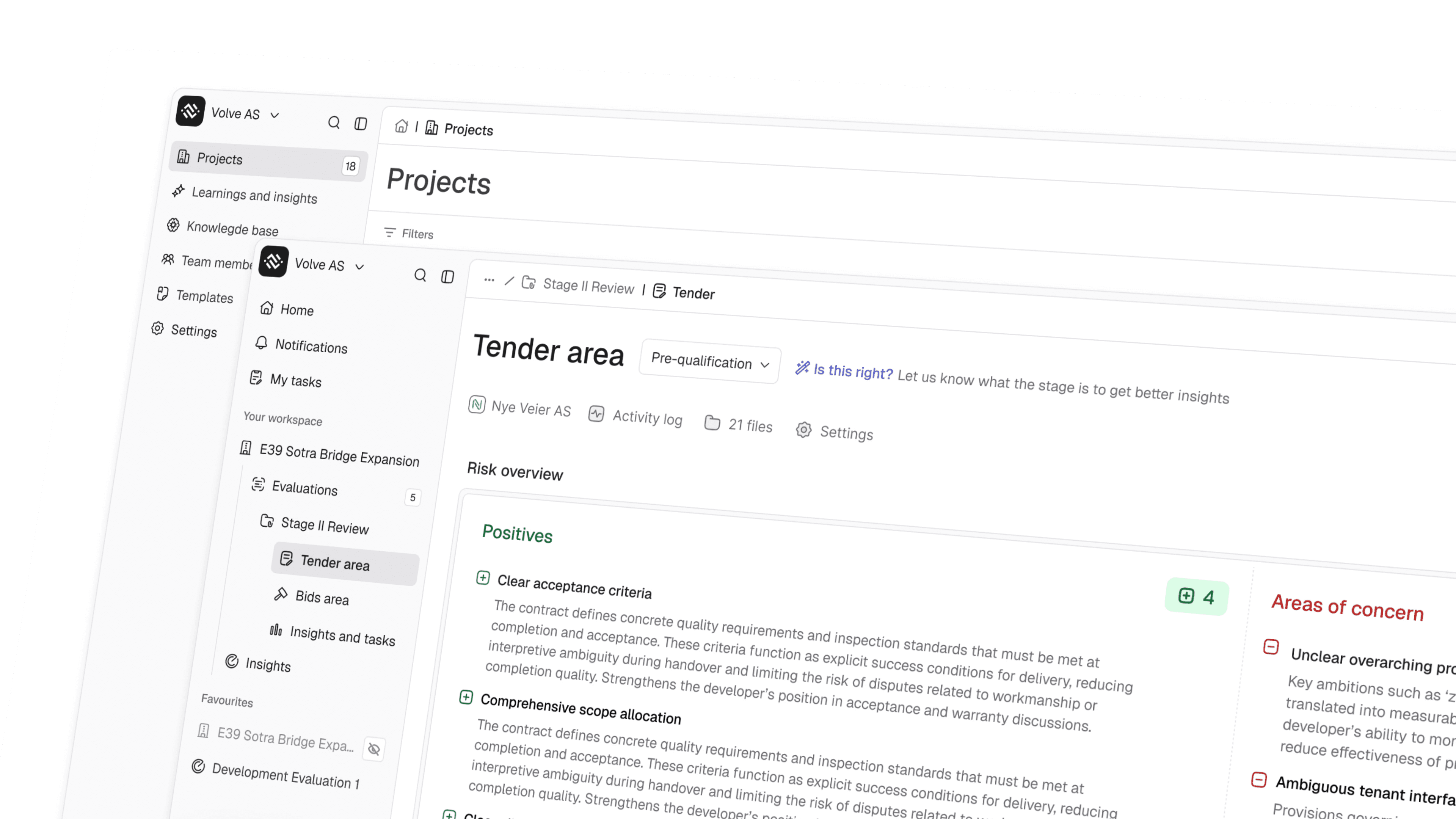
We use AI on the full text of tenders and project documents to help construction and infrastructure teams:
Check compliance against client requirements and criteria
Spot gaps and inconsistencies before they become debrief findings
Strengthen answers with clearer, more project-specific content and evidence
Keep traceable links back to the RFP, clarifications and source documents
If you want to improve tender quality scores, start by improving how you see and use the text you already have. Answer what the client actually asked. Then prove it, clearly.
Read more about why tendering in construction is… different, here.
See how Volve turns document complexity into decisions
Explore how construction teams surface risk, trace requirements, and carry a clearer baseline into delivery.