Volve Product Highlights 2025
Volve 2025 product highlights for construction: contract risk and standards, tender quality, early-phase analysis and change control.

Alf Jørgen Dovland
COO & Co-Founder
Before the new year gets fully underway, here is a look back at what actually shipped in Volve over the last twelve months.
Looking back at the year’s releases, most of the work landed in five areas:
Contract risk, clarity and standards
Tender quality, bids and learning
Change control and contract execution
Early-phase analysis and dependencies
Integrations and workflow
Below is a short recap of key highlights from each area.
1. Contract risk, clarity and standards
Deviations from contract standards
Early in 2025 we launched the first version of deviation checks against contract standards.
The platform can:
Identify deviations from a selected standard
Show the standard text side by side
Provide a simplified assessment of each deviation
This marked the beginning of checking content in Volve against external reference standards, not just analysing documents in isolation.
Contradiction detection in tenders and contracts
A classic risk in complex construction contracts is inconsistency across documents. Different parts say slightly different things about risk, responsibilities or deadlines.
To address this, the platform started analysing both tender documents and contracts to identify potential contradictions.
This helps teams:
Uncover inconsistent obligations and terms early
Clarify risk before submitting a bid or signing a contract
End up with cleaner agreements
Detection of vague or unclear wording
We also introduced detection of vague and ambiguous formulations in tender documents and contracts, a common source of friction because different parties can read the same sentence in different ways.
The platform flags:
Phrases that are open to interpretation
Requirements that are incomplete or unclear
This gives a better basis for quality assurance, clarifications, qualifications and internal risk discussions, before unclear wording turns into disputes.
Contract Scanner
Later in the year we released Contract Scanner, a new function for identifying clauses related to classic construction contract risks and disputes.
Contract Scanner:
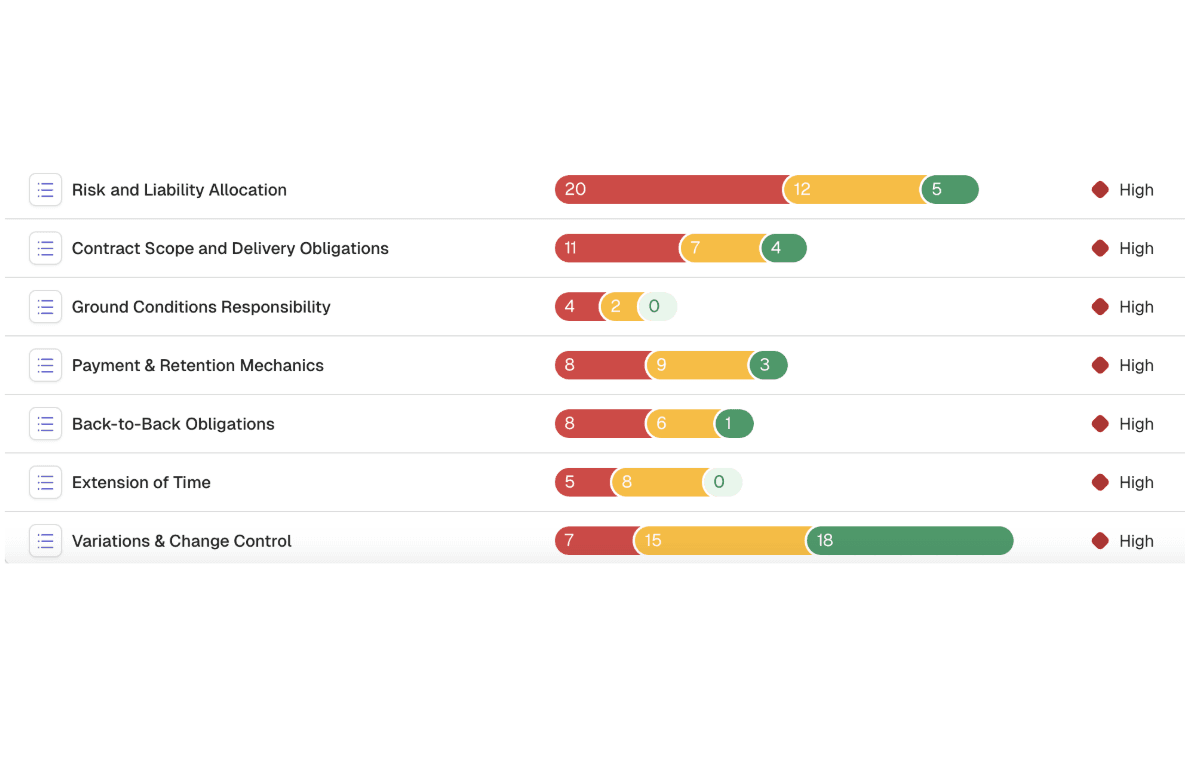
Identifies and groups clauses by key topics in construction contracts (for example responsibilities, deadlines, changes, liquidated damages and force majeure)
Provides simplified assessments of each finding:
Which party the clause mainly favours
The client’s general risk attitude
What level of attention the clause deserves
Makes it easy to handle findings directly in the platform (mark, comment and follow up)
This makes contract risk reviews more structured, repeatable and easier to share in a team.
Deviation checks against technical and other standards
Towards the end of the year we extended deviation checks beyond a single contract standard.
You can now run deviation checks against other types of standards: technical, environmental, or even internal company standards.
With many overlapping requirements in construction, this helps teams take control of deviations early and reduce the risk of errors, missed obligations and non-compliance later.
2. Tender quality, bids and learning
Tender analysis: execution plan
In 2025 we added a dedicated tender analysis tab for uploaded bids and launched the first version of automatic evaluation of a bid’s execution plan and understanding of the assignment.
The tool:
Analyses the execution plan
Gives a ranking or rating
Suggests concrete improvement points
Whether you are evaluating incoming offers or quality assuring your own bid, this opens up new possibilities to remove risk and increase the likelihood of winning.
CV evaluation against RFP requirements
We introduced automatic evaluation of CVs against the requirements in the RFP.
The platform can:
Check CVs against both role-specific requirements and overall project needs
Analyse strengths and potential uncertainties for each proposed person
Suggest how a CV can be tailored better to the project and role
Before submission, this lets teams:
Quality assure CVs in a more systematic way
Evaluate different project team compositions by uploading several alternatives
During contracting, it supports direct comparison and evaluation of offered teams.
Tender Learning v01
We also released Tender Learning v01 , learning in practice, where it matters most.
After a tender has been analysed, you can upload the client’s feedback or evaluation (especially relevant in public procurement). The platform then allows you to:
Automatically generate learning points
Use that learning directly in future tender analyses
This turns tender feedback from a static PDF into something you can actually reuse. Work on the next version has already started, with the aim to show development of tender quality over time across tenders and portfolios.
Automatic draft execution plan / method statement
For tender documents, we added the ability to automatically generate a draft execution description based on the criteria in the RFP.
This means that:
You start with a proposal already aligned with the specific tender and project
You can then review, sharpen and adapt it, instead of starting from a blank page
The first version ensures alignment with the actual RFP and project, and can take into account learning from earlier public tenders. The next version will adapt even better to each customer’s own historic tender responses.
3. Change control and contract execution
Smarter contract handling in projects
We strengthened contract handling in Volve for live projects.
You can now upload an unlimited number of contractual documents from project execution, such as:
Meeting minutes
Change documents
Invoices
Technical reports
Other relevant correspondence
Volve automatically links relevant information between the main contract and these attachments, taking into account time and priority, so you get clearer agreements and better control through the contract process.
Change assessment in the contract module
We added a dedicated change assessment function in the contract module.
When you have:
A new change notice
A discussion point
Or uncertain input ahead of a meeting
…the platform can analyse the situation based on:
The signed contract
Other contractual documents you have uploaded, such as meeting minutes, change messages, invoices and reports
That way, potential contractual changes get handled consistently, and documented, while the project is still running.
4. Early-phase analysis and dependencies
Early-phase module with dependency and sequencing analysis
We introduced a dedicated early-phase module.
When uploading early-phase material, you can select this module and get:
Its own classification and summary of content
Tailored analyses, including automatic identification of dependencies and sequencing requirements from planning documents
This gives faster overview and more targeted interaction in, for example, technical due diligence and other early-phase processes. It also opens up new ways to see how early planning assumptions might affect scope, risk and later execution.
5. Integrations and workflow
Custom Extractions
We introduced a dedicated Extraction tab to make it easier to work with structured information from the analysis.
Extraction gives you a list of all information Volve finds based on your own extraction rules, and lets you save and reuse those extractions across projects.
This makes it much easier to standardise how key data is pulled out from similar tenders and contracts, and to integrate those outputs into existing workflows and tools, for example:
Requirement detection and requirement overviews
Repeated reporting or checks you want to run on every new tender or contract
Over time, this turns your “typical checks” into reusable, systematic extractions rather than one-off manual work.
SharePoint integration (first version)
We also launched the first version of SharePoint integration.
Volve can now:
Connect to SharePoint for selected customers
Let users select and analyse documents directly from existing SharePoint libraries
Reduce manual downloading and uploading of RFP, contract and project files
This is an important step towards analysing documents where they already live, and towards deeper integration with customers’ existing document management and workflows.
Not the full list, but a clear direction
This overview only covers some of the larger product themes and selected new features from 2025.
In addition, we:
Shipped many smaller product improvements and user experience tweaks
Delivered customer-specific configurations and content
Made significant AI and infrastructure upgrades, so the platform can:
Handle larger document sets
Deliver more precise identifications and summaries
Do it faster and more reliably across portfolios
Where all of this is heading:
Deeper understanding of contractual and tender text
Closer connection to real project work in early-phase, tendering, execution and learning
More automation with full traceability back to the governing documents
If you want to see how these capabilities can support your tenders or contracts in practice, we are always happy to walk through a real example together.
Alf Jørgen Dovland
COO & Co-Founder
Share
See how Volve turns document complexity into decisions
Explore how construction teams surface risk, trace requirements, and carry a clearer baseline into delivery.