From personal expertise to portfolio intelligence
Construction projects are unique but their challenges repeat. How teams turn personal expertise into portfolio intelligence across tenders.
Key takeaways
Systematic learning in construction is hindered because vital expertise remains trapped in individual heads or locked in inaccessible, unstructured document archives.
Organizations can build portfolio intelligence by using AI to connect tender requirements, bid responses, and outcomes across past projects.
Linking past changes, claims, and feedback to the original contractual text allows teams to query historical data and make smarter future decisions.
Every construction project is unique. New site, new stakeholders, new constraints, new contracts. Yet the problems are strangely familiar. Scope creep and unclear boundaries. Ground, utilities and interface risk. Coordination across disciplines and partners. Regulatory approvals that drag. Contractual misunderstandings that grow into disputes.
In theory, this should create strong learning curves. “We ran into this last time. Let’s handle it better next time.” In practice, many organisations feel like they’re re-learning the same lessons across bids, projects and clients.
So why is learning so hard in construction.
Learning mostly lives in people. And people don’t travel reliably
A lot of construction learning is experience. It lives in senior people’s pattern recognition. What usually goes wrong on this type of job. Which clients interpret interface boundaries aggressively. Which standards are painful in practice. How local authorities really read the regulation, not just how it’s written. Which clauses tend to turn into notice and change fights.
That experience is valuable. And hard to scale.
Teams change from project to project. Even when the same company names appear, the actual group is rarely the same group that lived through the last job. So even if the organisation learned something, the new team may not have. The learning exists somewhere, but it doesn’t reliably arrive with the project.
People also move. They get pulled into crises, switch projects, switch companies, or retire. When learning mainly lives in heads, organisations don’t lose the slide decks. They lose the context and intuition behind them.
“Lessons learned” often stay on the shelf
Most organisations try to formalise learning through close-out workshops, lessons learned documents, and reviews of major issues. The intention is good. The output often becomes a PowerPoint in a folder or a PDF nobody opens.
Meanwhile, the richest record of learning sits quietly in the background:
Tender requirements and evaluation feedback
Your bids, clarifications and assumptions
Signed contracts and negotiated amendments
Variations, claims, and how they were resolved
Regulatory correspondence and approvals
This is experience in text form. What was asked. What was promised. What was agreed. What changed. What caused friction. What worked.
The problem is that this material is complex, distributed, and unstructured. It’s hard to search in a way that answers real questions, and it’s hard to connect it into a chain from early assumptions to later outcomes. So it rarely becomes reusable knowledge.
A simple example shows why this matters. A tender assumption about access or third-party approvals becomes a programme dependency. That becomes a notice question when it slips. That becomes a change discussion when costs move. If you can’t connect that chain across documents, you can’t reliably learn from it.
Expertise concentrates in a few key people
Most organisations have a short list of names everyone relies on. “Ask her, she’s been through this.” It works in the moment, but it’s fragile.
If critical context depends on a handful of individuals, you don’t have organisational learning. You have local learning that may or may not reach the next bid or project.
The best mitigation we have. And its limits
One practice works well when done properly. Before a major tender or project, gather experienced people and walk through risks and challenges together. Design, construction, commercial, legal, HSE. Sometimes regulators or key partners.
You ask:
What usually goes wrong in this type of project.
With this client and these regulations, what should we expect.
What’s different this time. What should we watch out for.
When it’s done well, it compresses years of experience into a few hours. The downside is that it’s hard to run consistently, the output doesn’t travel well, and it still depends on who happened to be in the room and what they remembered that day.
It’s good practice. It’s just not enough for systematic learning across a portfolio.
The cost of not learning
Weak learning shows up in many small ways, and a few big ones. Known client concerns aren’t addressed, so bids lose points. Risk allocation mistakes repeat across tenders. Regulatory hurdles are handled ad hoc each time instead of improving a playbook. Claim and dispute patterns recur with no real reduction over time.
Two concrete costs show up again and again. Lost bids. And margin that disappears in delivery.
From personal expertise to portfolio intelligence
The point isn’t to replace individual expertise. It’s to strengthen it, and add something most organisations lack. Portfolio intelligence.
Portfolio intelligence means using what you already know across many tenders and projects, systematically. For example:
In tenders, see which topics repeatedly show up in evaluation feedback, and how that changes over time.
In contracts, see which clause patterns correlate with smoother delivery, and which ones repeatedly turn into claims.
In approvals, see what documentation styles and mitigations have worked best with specific authorities.
None of this replaces judgement. It gives judgement better input, anchored in real text and real outcomes.
What the right kind of AI looks like
When people hear “AI in construction”, they often think about design automation or drafting. That’s not the core problem here.
AI for learning needs three things:
Work on your actual tender and project documents
Understand structure around risk, responsibility, regulation, and outcomes
Help you ask simple, powerful questions about your own history
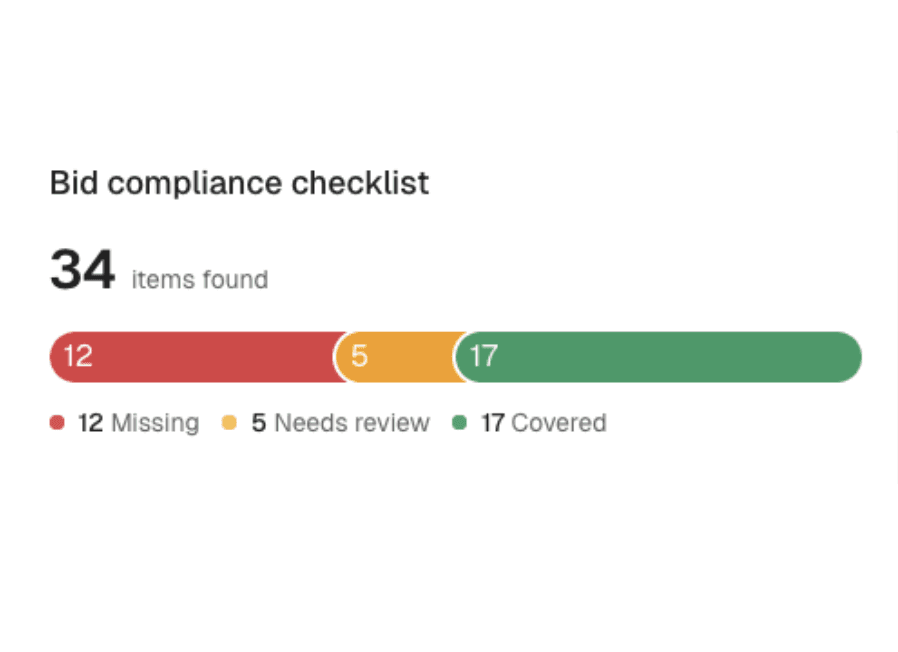
It needs to see the chain, not isolated files. Across RFPs, bids, clarifications, feedback, contracts, changes, variations, claims, and correspondence. Otherwise, it becomes just another search box.
With that view, teams can ask questions that are hard to answer today:
When we saw this combination of scope, risk and regulatory context, what tended to happen later.
When clients marked us down on interfaces or regulatory understanding, what did we actually write.
Which contract clause patterns became repeat issues, and which didn’t.
The AI isn’t deciding for you. It’s giving you a portfolio memory you don’t have today. Prior experience becomes something you can query, not something you hope people remember.
What we do at Volve
At Volve, we connect contractual documents and project text so customers can reuse past experience, good and bad, and let each new bid and project start smarter than the last.
In practice, that means making it possible to link requirements to responses, responses to contracts, and contracts to what happened in delivery. It means turning feedback, changes and claims into patterns you can act on. And it means making those insights traceable back to the original text, so teams can trust them and use them.
Projects will always be unique. But your response to familiar challenges doesn’t have to be. If you want, we can show what portfolio memory looks like using a real set of tenders and project documents.
Read more about why in construction, you don’t only win a project once here.
See how Volve turns document complexity into decisions
Explore how construction teams surface risk, trace requirements, and carry a clearer baseline into delivery.