Searching is expensive. Missing information is worse
Searching construction project documents is expensive, but missed requirements, deviations and obligations cost far more. How to find both.
Key takeaways
The true cost of poor document management in construction is not just search time but the missed requirements that drive margin erosion and disputes.
Traditional search tools find files, but construction projects need contextual answers that recognize precedence between specifications, clarifications, and contract clauses.
Surface-level search often obscures critical obligations, whereas surfacing information within the specific workflow of a task helps experts judge risk accurately.
You don’t need a study to know this. Construction teams spend a lot of time looking for information. The same questions come up on almost every project:
Where is the latest version of that spec.
Did we get a clarification on this in the tender.
What did we agree in the last variation.
Where in the contract is this actually defined.
Everyone feels that searching is expensive. But the bigger cost isn’t the time you spend searching. It’s what happens when you don’t find what you need in time.
That’s when requirements slip. Deviations go unnoticed. Obligations get missed. And that’s when risk, cost and disputes show up.
The everyday reality. Hunting for answers
Across tendering and delivery, a lot of time disappears into small, invisible tasks. Digging through shared drives and portals. Opening slightly different versions of the same document. Forwarding “do you have the latest” emails. Re-reading long PDFs just to locate a single clause.
You see it in late nights before submissions. Slow responses to client questions. Coordination meetings where people scroll through folders instead of discussing decisions.
Most teams accept it as “just the way it is”.
The real problem. The cost of not finding
The more dangerous part is the one you don’t see on a timesheet.
It’s the requirement that never made it into the offer. The clarification that changed risk, but never reached the people pricing or planning. The variation that was agreed, but didn’t flow properly into downstream documents or subcontract scope. The responsibility you miss when assessing a change because the relevant clause was hiding in a different annex. The deviation approved in one channel, but never captured in the formal contract.
You rarely feel these the same week they happen. They show up months later. As margin erosion, rework, delays, and claims. As difficult conversations with clients and partners that both sides would rather have avoided.
A common pattern looks like this. A tender clarification tightens an acceptance criterion. The pricing team doesn’t see it, because it sits in a Q&A log rather than the main spec. The bid is submitted on the old interpretation. Delivery plans from that baseline. Then the issue surfaces during testing, and it turns into an argument about what was actually included. The information existed. The right people didn’t see it in time, in the right context.
Why traditional search isn’t enough
Most organisations already have “search”. You can search the file system. You can search in SharePoint or a document management tool. You can search your email.
The problem is that these tools are designed for files and messages, not for the meaning inside contractual documents.
They don’t recognise that a requirement in one annex and a clause in another are really about the same obligation. They don’t understand precedence, like when an addendum or clarification overrides an earlier specification. They don’t connect a variation order to the meeting minutes where the change was first agreed, or to the clause that defines how it should be priced.
So teams fall back on informal systems. They ask colleagues who “know where things are”. They re-read entire documents to feel safe. They make judgement calls based on partial information, because connecting the full picture takes too long.
Search finds documents. Projects need answers.
From searching to surfacing what matters
At Volve, we’re not especially interested in search as a standalone feature. We care about something slightly different. Surfacing what matters, when it matters.
In practice that means:
If you’re writing a method statement, you should see the requirements, constraints, and clarifications that actually apply. Without hunting through folders.
If you’re reviewing a variation or a claim, you should see the full context chain. What the tender said. What the contract says. What’s been clarified since. Which clauses and requirements this change interacts with.
If you’re pricing a risk item, you should be able to ask where that risk appears across the contractual set. Then see the related text, side by side, with traceable links back to source.
Instead of generic search, you get contextual insight. You can ask questions like:
What in our contractual information impacts ground risk on this project.
Is this execution plan responding to all relevant RFP requirements.
Where do we talk about access and working hours.
Which tender clarifications override this part of the specification.
The system does the hunting. Humans do the judging.
How Volve helps teams miss less
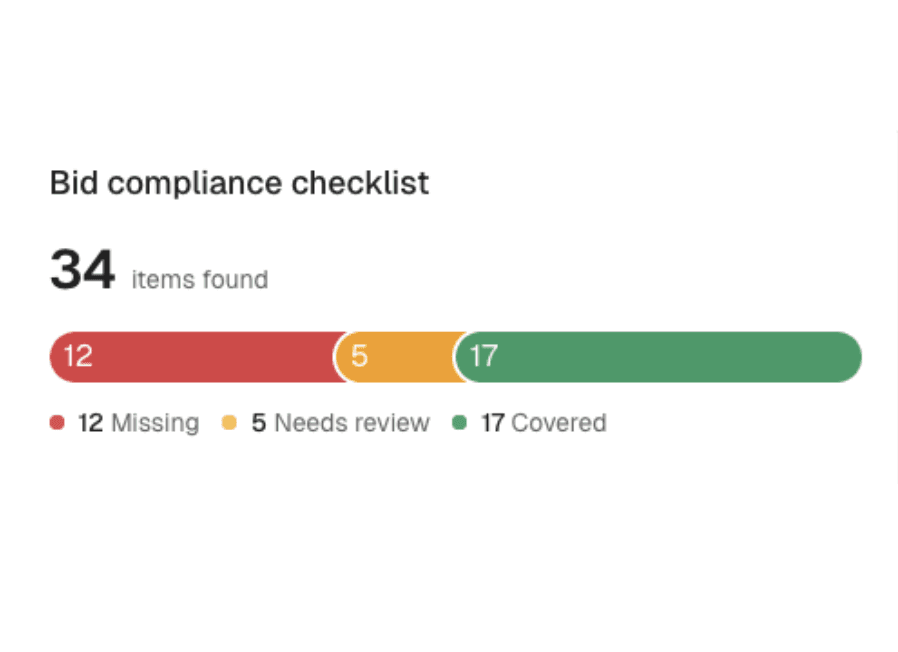
Volve uses AI on the text of contractual documents to connect related content across tenders, bids, contracts, specifications, changes and correspondence. It highlights potential gaps, overlaps or contradictions. It can check a bid draft against the RFP for coverage gaps. And it presents information in the flow of work, not buried in a folder tree.
The goal isn’t to replace experts. It’s to avoid situations where experts are forced to decide without seeing all relevant information. Or where they spend their time acting as human search engines instead of working on execution, risk mitigation and the commercial position.
Searching will always exist. But in complex projects, the advantage isn’t how fast you search. It’s how rarely you have to.
Read more about how project decisions in construction lives in documents here.
See how Volve turns document complexity into decisions
Explore how construction teams surface risk, trace requirements, and carry a clearer baseline into delivery.