EU draft procurement rules would end lowest-price tenders
Leaked drafts of the EU’s new procurement regulation would put a floor under quality weighting. Volve ran the data on 50,000+ European works contracts.

Herman B. Smith
CEO & Co-Founder

The short version
The leaked draft would end awards on price alone in public construction. Quality would carry at least 30% of the score, possibly 50% for works. In markets like Sweden and Germany, where most contracts still go to the lowest bid, that changes how work is won.
The risk moves from underpricing to overpromising. When quality carries up to half the score, the commitments in your quality response become contract obligations, and a bid can lose money on promises as easily as on price.
The draft appears to make an open-negotiated procedure the default, abolish the restricted procedure and competitive dialogue, and remove shortlisting on selection criteria. Fields get bigger, hit rates lower, negotiation standard.
Nothing is law yet, but the direction is set. The proposal lands 9 September, application is years away, and buyers are already moving this way. Tracking quality weightings in your pipeline and tightening bid and no-bid discipline costs nothing now and pays off whatever the final text says.
What leaked, and why the instrument matters
On 9 July, drafts of the European Commission's new public procurement regulation reached Reuters, Euronews, Bloomberg and MLex. The headlines went to Buy European: public buyers could exclude bids with less than 50% European content on large contracts and apply an optional European preference. For contractors, that is the least interesting part of the document.
The scale is settled. Public procurement runs to roughly 15% of EU GDP, about 2.5 trillion euros a year, and as the draft puts it, "the way public buyers spend money has become a matter of strategic relevance." The bigger structural choice is the instrument. One regulation would replace the three 2014 directives, apply directly in every member state with no national transposition, and shrink national discretion above the EU works threshold. One rulebook in 27 markets, though not one market: contract standards stay national, and evaluation culture changes slower than law.
For Norway there is an extra layer. Today's regime sits in “anskaffelsesloven”, Norway's public procurement act, via the EEA Agreement, and a regulation would normally be incorporated as written. But parts of the draft rest on trade and security policy, which has historically sat outside the EEA. What applies in Norway, and whether EEA operators count as European for preference purposes, are open questions from September.
The quality floor
The provision that changes bidding sits below the origin rules. Contracts would be awarded on the best price-quality ratio, with quality carrying at least 30% of the score, rising to at least 50% for labour-intensive contracts. One caveat first: the leak does not define labour-intensive. Construction reads like the obvious case, but works contracts carry a heavy materials share, and the final text could place works under the 30% floor instead. Both scenarios are measurable, so we measured both.
Averaged across the EU27 in 2023, we estimate price carried more than half the score in about 83% of awards. That is the share a 50% quality floor would force to rebalance. Under the general 30% floor, meaning price weighted at least 70%, the figure is still around 64%. France is the swing market between the scenarios: 46% exposed under the strict floor, 10% under the loose one.
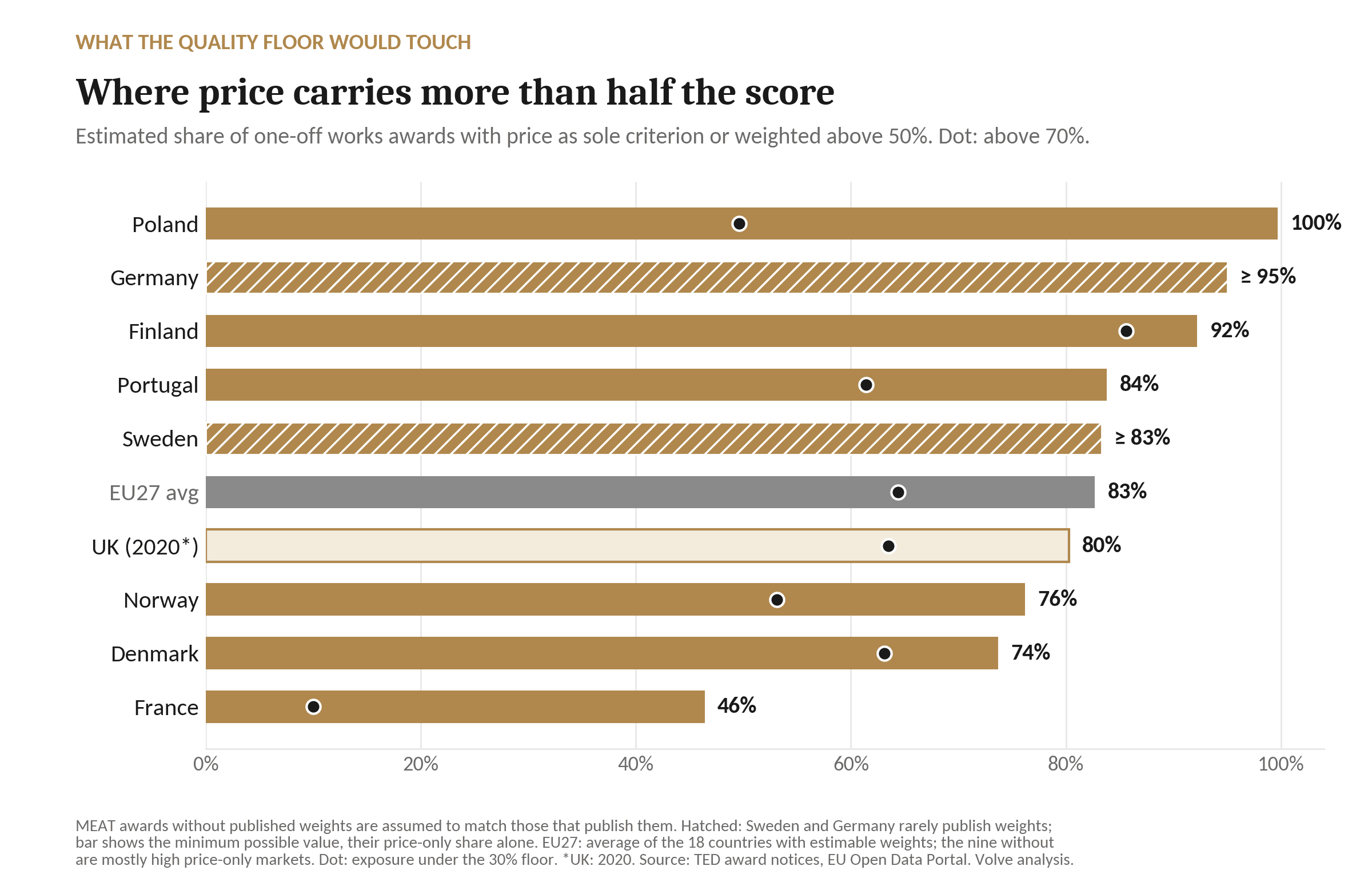
Whichever floor applies, the competitive logic shifts. When half the score is qualitative, the winner's curse changes shape. The classic failure was underpricing the job. The new one is overpromising in the quality response, because commitments scored at award become obligations in delivery. That means the quality response needs the same review discipline as the estimate.
Where it bites
The cleanest single measure is the share of contracts still awarded on price alone, since those awards would not be possible at all under the draft as leaked. We stripped out framework agreements and kept the standalone contracts a contractor prices from scratch.
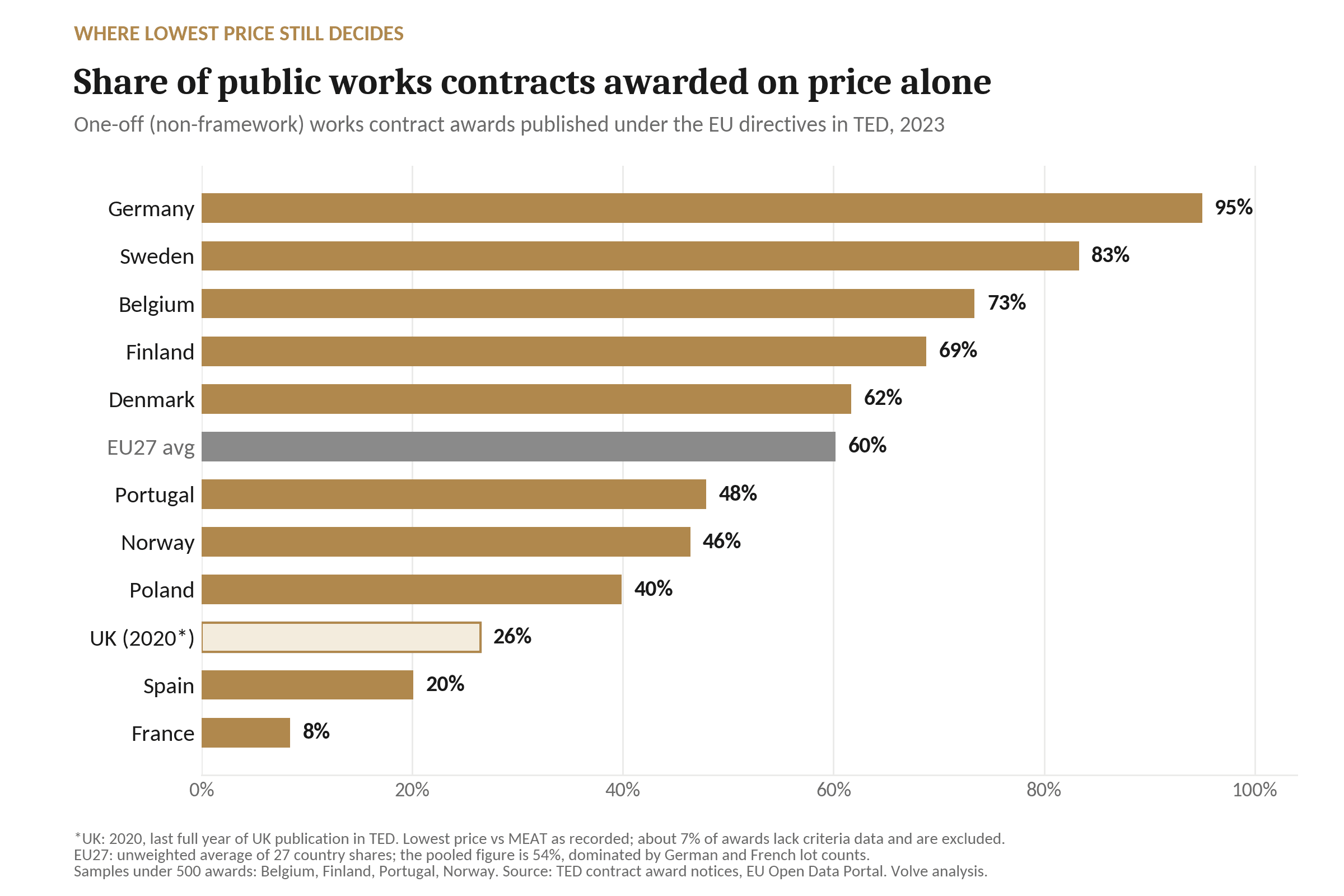
The Nordics are usually described as one quality-oriented market. The award data disagrees. Sweden gave 83% of one-off works contracts to the lowest bid in 2023, up from 79% in 2020, a tradition that runs deep in municipal and civil works under LOU, the Swedish Public Procurement Act. Finland sits near 69%, high and edging down. Denmark sits around 62% and has been flat for years. Norway is the quiet exception at around 46%, with a twist: weighted by contract value the share rises to 55%, because the largest infrastructure clients have moved parts of their portfolios toward price. If the 50% floor survives, Sweden faces the biggest scoring reset in Europe outside Germany.
Germany tops the table at 95%, with a fairness note: German law requires splitting works into trade lots, so the count is dominated by small trade packages rather than general contracts. Belgium runs high at 73%.
Spain reads differently depending on which number you look at. Only 20% of Spanish works awards go on price alone; the 2017 procurement law did move Spain to multi-criteria scoring. But where weights are published, price still carries more than half the score, though only a fifth of Spanish quality-scored awards publish them. Quality is scored, and price still decides more often than the price-only figure suggests. France, at 8% price-only, is the one large market where the strict floor would be a genuine reset rather than a codification of practice.
The UK ran the experiment early
The UK is outside the regulation and inside the trend. The Public Procurement Act, live since February 2025, replaced the "most economically advantageous tender" with the "most advantageous tender", a one-word change that widens what buyers may score, and formalised non-price requirements, building on earlier central government policy of minimum social value weightings. The baseline is the instructive part: in 2020, the UK's last full year in TED, only 27% of one-off works awards went on price alone, yet price still carried more than half the score in an estimated 80%. The UK dropped price-only awarding without dropping price-heavy scoring, and the early experience under the Act, heavier submissions and audited commitments, follows from that gap. For UK contractors bidding into the EU, the GPA keeps the door open; content rules and ownership screening become new eligibility variables.
Procedure, origin, security
The draft appears to make an open-negotiated procedure the default, abolish the restricted procedure and competitive dialogue, and remove shortlisting on selection criteria. Fields get bigger, hit rates lower, negotiation standard.
Alongside that, the homework moves forward in the process: buyers could reject large bids with under 50% European content, and screen whether a bidder's ownership, financing or exposure to third-country law creates an interference risk. Material origin for critical packages and the ownership of subcontractors and JV partners become things you establish before submission, not after award. Call the package what it is: consolidation, not simplification. Fewer procedures, more evaluation dimensions. The paperwork moves from procedure into criteria.
Timeline, and what to do now
Proposal on 9 September, then Parliament and Council, then transition. Realistic application is late in the decade, later in Norway once EEA incorporation is added. Buyers are not waiting; the draft largely codifies where evaluation practice is already heading. Three moves cost nothing regardless of the final text: track quality weightings in your own tender pipeline market by market, build origin documentation for recurring critical packages before anyone demands it under deadline, and tighten bid and no-bid discipline before open-by-default fields make it expensive to learn. All three land in the pre-award phase, which is where we work at Volve: understanding what a tender actually asks for before the tender is priced. Talk to us about your tender pipeline and we'll show you what the data says about it.
About the numbers
All figures are based on contract award notices published on TED (Tenders Electronic Daily) for works contracts under the EU public procurement directives: 2023 for all markets, 2020 for the UK, its last full year in TED. Framework agreements are excluded, so the figures describe standalone contracts. "Price alone" means the notice records lowest price as the sole award criterion. The price-weight estimates use published criteria weightings where available and assume unpublished ones look like the published ones; where too few weights exist, we show only minimum values. EU figures are unweighted averages of country shares. These are estimates from notice data, not audits of evaluation reports, and TED coverage and notice quality vary by country.
The Commission's Single Market Scoreboard shows lower shares on 2024 data, including 47% for Sweden across all public procurement. 2024 was the first full year of the new eForms notices, which record award criteria differently; in the 2023 notices used here, the last complete year under the old forms, Sweden sits at 87% across all public procurement and 83% in the one-off works shown on the chart.
Sources
Reuters, 9 July 2026 (via Euronext)
Euronews, 9 July 2026
MLex, 9 July 2026
McCann FitzGerald client briefing, July 2026
European Parliament Legislative Train
TED contract award notices, EU Open Data Portal.
Herman B. Smith
CEO & Co-Founder
Share
See how Volve turns document complexity into decisions
Explore how construction teams surface risk, trace requirements, and carry a clearer baseline into delivery.