Trusted by leading construction teams for clearer commitments and a competitive edge



















The problem
Pre-award isn't really about writing text. It's about answering for a review: which obligations you took on, what the price rests on, what got missed. That's where a general-purpose tool quietly comes apart.

It only reads what you ask about
Point it at a question and it answers that question. On a large set it skims, and never shows what it skipped. The gap you didn't think to look for stays hidden.

Its citations are approximate
It can point at a file, but not the right version. It doesn't track addenda or what overrides what. On a tender, the wrong version is the wrong answer.

Ask twice, get two answers
It's built to generate, so the same documents can read differently tomorrow. A review you can't repeat isn't a review.

It mixes one bid up with another
Load a few document sets and they bleed into each other. Comparing bids turns into a source of mistakes rather than clarity.

No structured memory of your bids
No shared record, no memory of the last ten tenders. Every review starts from a blank page.

You can't see its work
When a commitment is challenged after signing, there's nothing to point to: no source, no version, no trail.
Why Volve
Volve has one job: turn your document set into a review you can stand behind. Here's what that looks like.
Traceability
Volve ties each requirement, risk and obligation to the clause it came from, in the version that governs, and it knows what the addenda override.

Coverage
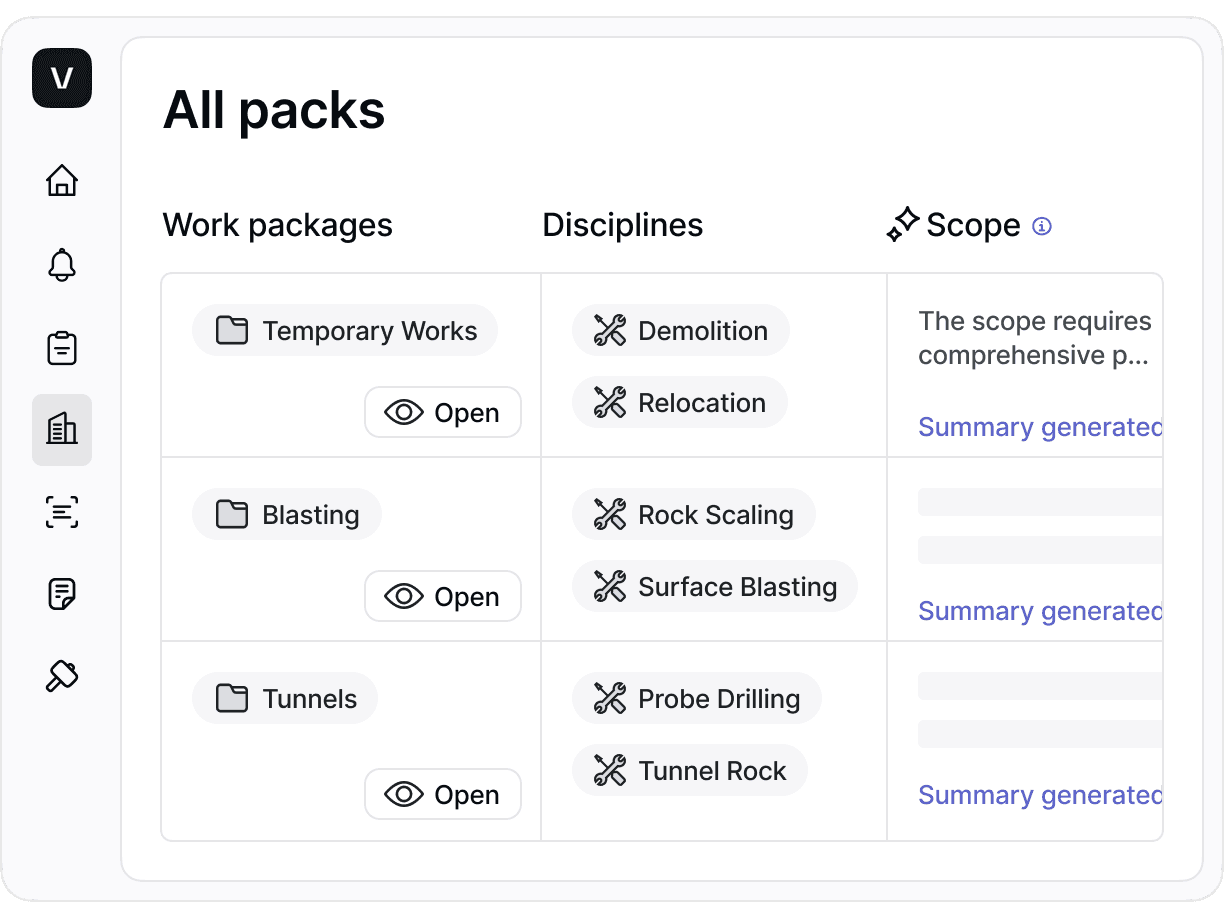
Volve reads every document and shows your coverage, flagging the gaps, deviations and contradictions, not just answering the questions you thought to ask.
Baseline & memory
Findings, positions and risks live in one traceable baseline the whole team works from, and they carry into the next tender. Build on what you already know.

Head to head
Most teams use both, and they should, just for different jobs. Here is how they compare across commercial construction workflows.

Last verified on August 2026. We frequently review and update this comparison to keep it accurate.
Why the gap won't close
What matters in a tender rarely sits in one place. It lives in the links between documents like a requirement pointing to a clause, a clarification overriding a spec, or a change moving a quantity.
Volve is bult on:

Industry logic (obligations, hierarchy, deadlines and risk, modelled on the document structure)
Workflow data (how requirements, deviations and decisions connect from tender to execution)
Those links exist nowhere else. Not on the internet, not in any training data. They have to be built, per tender, from your documents. That's the work Volve does, and it's why a better language model on its own can't close the gap.
Proven across 2,500+ real construction projects, and counting.

See it on your own tender

Discover how Volve surfaces hidden risks and obligations before you price
See how traceable insight replaces manual reading and Control-F across every file
Get a clear view of tender risk without slowing your team down
VOLVE INSIGHTS
Costly tender mistakes live between documents, not inside them. How reading construction tenders as connected requirements reduces bid risk.
FAQ