
Used on more than 2,500 construction projects






Each document is consistent on its own. The gaps sit between them.
The specification, the drawings, the model and the client requirements are written by different people, at different times. The scope that costs most after award is the scope no single document owns: an interface, a “by others”, a standard referenced but not supplied.
01
Scope spread across documents
The requirement is in the specification, the detail on a drawing, the quantity in the model. Nobody reads all three together.
02
Interfaces with no owner
Where two packages meet, each assumes the other has it.
03
Design responsibility unclear
What you design, and to which stage, is set in a clause the technical team may never see.
The technical review, step by step.
Volve follows the technical review, from the requirements in the specification to the drawings and model that should carry them.

Requirements organised into work packages and disciplines for your project type
Building, infrastructure and energy, each with its own packages
Each requirement with its clause or sheet

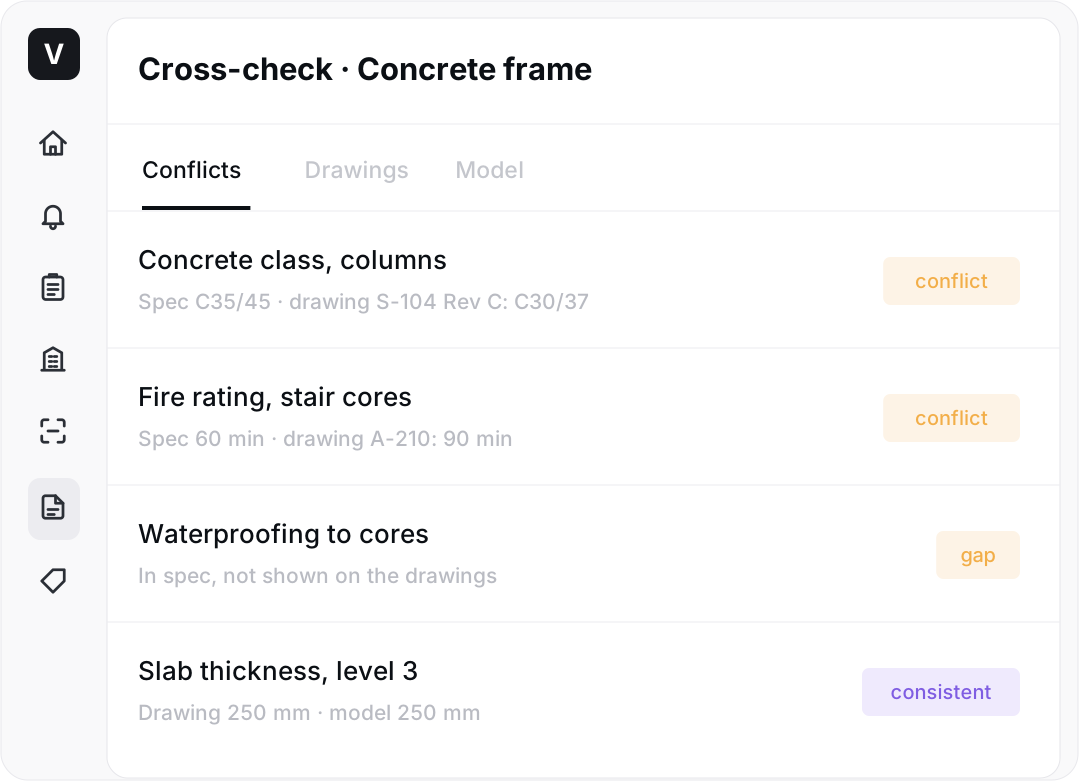
Conflicts between drawings, specification and model surfaced
Drawings as PDF or DWG, models as RVT or IFC
Each conflict side by side, with the sheet and the clause
Interfaces between packages listed, with the owner each document gives them
Design scope and stage per package, from the contract and the drawings
Gaps raised as clarifications before they become your risk

From tender documents to a traceable scope.
Volve reads what the documents say. You decide how each gap closes.
Covered: placed in a work package, traced to the clause or sheet
Unclear: referenced or implied, but not defined in the pack
Conflict: the documents say different things
Gap: no document or package carries it
What technical teams ask Volve to do.
Tasks from a normal tender week. Every answer comes with its source.
“By others”, and no one has it
Every “by others” assumes someone else carries it. Often, nobody does.
“List every item marked by others, and who the documents say the others are.”
What comes back
Each item with its clause or sheet, and whether any document names an owner.
Drawings against the specification
The drawing shows one thing, the specification another, and the price follows whichever the estimator read.
“Where do the drawings and the specification disagree on the concrete frame?”
What comes back
Each conflict side by side, with the sheet and the clause.
Interfaces between packages
Where two packages meet, each assumes the other has it.
“Which interfaces between the mechanical and electrical packages have no owner?”
What comes back
Each interface, the packages either side, and what each document says about it.
Standards referenced, not supplied
A requirement you can’t read is a requirement you can’t price.
“Which standards and client documents does the specification reference that aren’t in the pack?”
What comes back
Each one with the clause that references it, ready to request in a clarification.
Design responsibility and stage
Design is often taken on in a single clause, at a stage the drawings don’t match.
“What design are we taking on, and at what stage are the drawings?”
What comes back
Design scope per package from the contract, and the stage as labelled and as drawn.
What the addendum changed
The last addendum moved the scope, and not every package has caught up.
“What did addendum 2 change in the scope, and which packages does it hit?”
What comes back
Every changed requirement, the package it sits in, old and new, with the source.
GO FURTHER
The patterns, the checklist and the structure
Tender pattern · one-page note
Top 7 scope gaps in construction tenders
Where scope falls between the documents, and what to check.
Checklist
How to check scope across the documents
Ten checks before the scope goes into the price, with a workbook that traces every requirement.
Insight · project types
What a school, a metro line, a dam and a hospital have in common
Why scope is structured per project type.

Scope you can defend
Every requirement shows the clause or sheet it came from.

The same method every time
Your project type’s packages, disciplines and checks on every tender.

Time back for judgement
The reading and cross-checking are done. The team’s hours go to the interfaces, the design and the clarifications that matter.
From the design team to the estimate.
Technical, estimating and bid teams work from the same structured scope. Findings and clarifications are shared and traceable, so the scope the bid team priced is the one the project team inherits.

Technical leads & design managers
Review requirements, interfaces and design responsibility in one place.

Price a scope that has been checked against the drawings and the model.

Bid & tender managers
Raise the clarifications that matter before the question deadline closes.

As a BIM coordinator, I use Volve to quickly identify what I need to extract from the model to support quantity estimation. It helps me connect the tender documents with the BIM work and saves a lot of manual searching.

Sebastian Reinholdtsen
BIM coordinator, AF
Bring one tender pack and we’ll run it through Volve with you. You’ll see the scope structured into work packages, the conflicts between the drawings, specification and model, and the gaps no document owns. Your team makes the call.

A working session on your own documents
Scope, conflicts and what no one owns
No preparation needed from your team
Book a 30-Minute Demo
By submitting this form I agree to my details being used in sole connection with the intended enquiry. Please check our privacy policy to see how we protect and manage your submitted data.