What a school, a metro line, a dam and a hospital have in common, and what they don't
A school, a metro line, a dam and a hospital share their earthworks and almost nothing that decides the price. How Volve structures tender scope by project type.
Herman B. Smith
CEO & Co-Founder

Put the four tenders side by side and you can notice that a portion of the work is similar. Each starts with a site to establish, ground to move and drainage to lay, and ends with systems to test and documents to hand over. An estimator who has priced a school can read the civils in a dam tender without a dictionary.
The second thing you notice is that none of that is where the price is decided. The school is won or lost on the building trades. The metro line on track, traction power, signalling and the stations it carries. The dam on the dam body, the spillway and the safety regime over all of it. The hospital on medical gases, isolated power, controlled ventilation and radiation shielding, with half the work done next to patients. Those packages share nothing with each other, and they carry the risk.
The list is not the price
Read as a list, a tender is clauses, requirements and items, tagged by discipline. The list treats the roof membrane and the medical gas system as entries of equal weight, because that is what they are in the document. It is not what they are in the price.
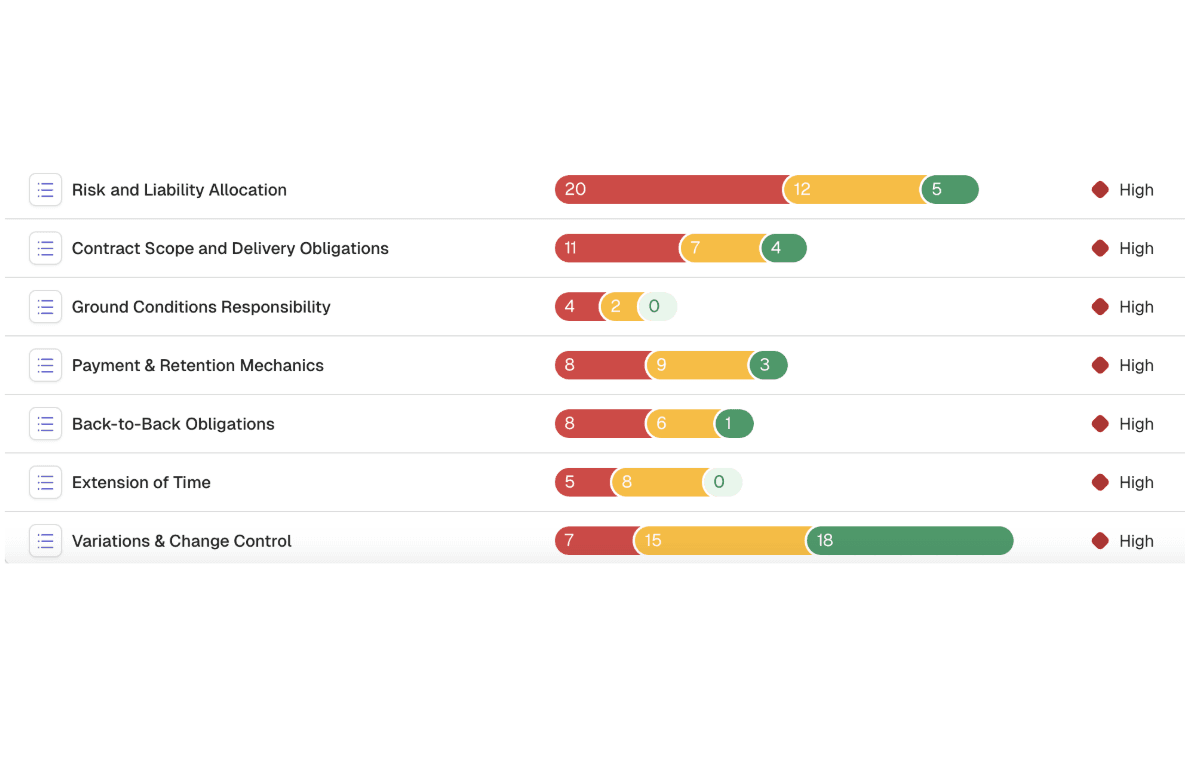
The result is false comfort. Coverage looks complete, but "mechanical" now holds the whole process train of a treatment plant, commonly the largest single share of the contract, and "civils" holds a dam body whose construction method decides the risk profile of the job. The gap does not show at review. It shows at pricing, or after award.
The difference is structure, not detail
A hospital and a school have the same shell. Inside, the hospital has a second building's worth of systems the school will never have, each with its own standards and commissioning. Every mature market has a separate body of healthcare building standards because the difference is that large.
A metro line and a road are corridors through the same ground. The road has pavements and road furniture. The line has permanent way, catenary, signalling and, when let as a line contract, stations with platforms, passenger systems and underground life-safety inside the same tender.
A substation and a hydropower plant both end at a grid connection. One is apparatus and lines. The other is a dam body, pressure shafts, turbines and a dam-safety class. One heading called "energy" tells you nothing you can price.
All of this is the execution layer, what has to be built and by whom. The contract layer above it, the form of contract and its risk allocation, is largely the same whether the asset is a school or a hospital, and Volve holds it separately. This piece is about the layer that changes with the asset.
Shared where the work is the same
The shared part is what makes the whole thing maintainable. Earthworks are earthworks. Tunnelling is tunnelling whether the tunnel carries trains, cables or water. Structure those packages once and reuse them, and a contractor reads a road tender and a wind-farm tender in the same language, and a fix to the earthworks checklist lands on every project type at once.
Shared where the work is the same, dedicated where it is not, and nothing defined twice.
Inside the construction commercial graph
Volve holds a tender as a graph, in the plain software sense of things and the links between them. The documents are nodes, so are the clauses, requirements and quantities inside them, so are the packages and work types of the project type, work types being the trades and systems inside a package. The edges are the links. Which requirement lands in which package, which package touches which, which drawing bears on which price.
This is what we mean by a construction commercial graph, and this is the part of it that changes with the asset.
Three categories, buildings, infrastructure and energy, with project types under each, every type with its shared packages and its dedicated ones. Around sixty packages and over three hundred work types, each with a scope definition, the risk drivers that tend to move price and programme, and the questions an estimator should be able to answer from the documents.
The structure comes from the project type; the content comes from the documents. Each document is first broken down into what it contains: the contract into clauses, the specification into requirements, the drawings into elements and quantities, the bill into items. Then the pieces are mapped onto the standard breakdown for the type. A work type with nothing linked to it stays visibly empty. Either it is not part of this job, or nobody has specified it. Both are worth knowing before you price.
Packages are not silos. A concrete specification touches foundations, superstructure and, on an aquaculture site, the tanks. Those touches are drawn as interfaces between packages, and interfaces are where scope most often falls between two subcontractors.
The estimator reads that graph for quantities and price risk, the bid manager for what the tender does not say, the project manager for interfaces and sequence, procurement for what to package and to whom, the subcontractor for the slice that is theirs. One graph, different views, no drifting copies.
Where it shows
The specification for an office ground slab calls for C35/45 in exposure class XC4. A drawing detail leaves an edge exposed to de-icing salts, which is XD3 or XF4. Different concrete, different cover, different price. As a list, that is two requirements in two documents. In the graph they sit in the same package, the conflict is an edge, and the edge runs on to the bill item that prices the slab. The risk is visible before anyone has priced it.
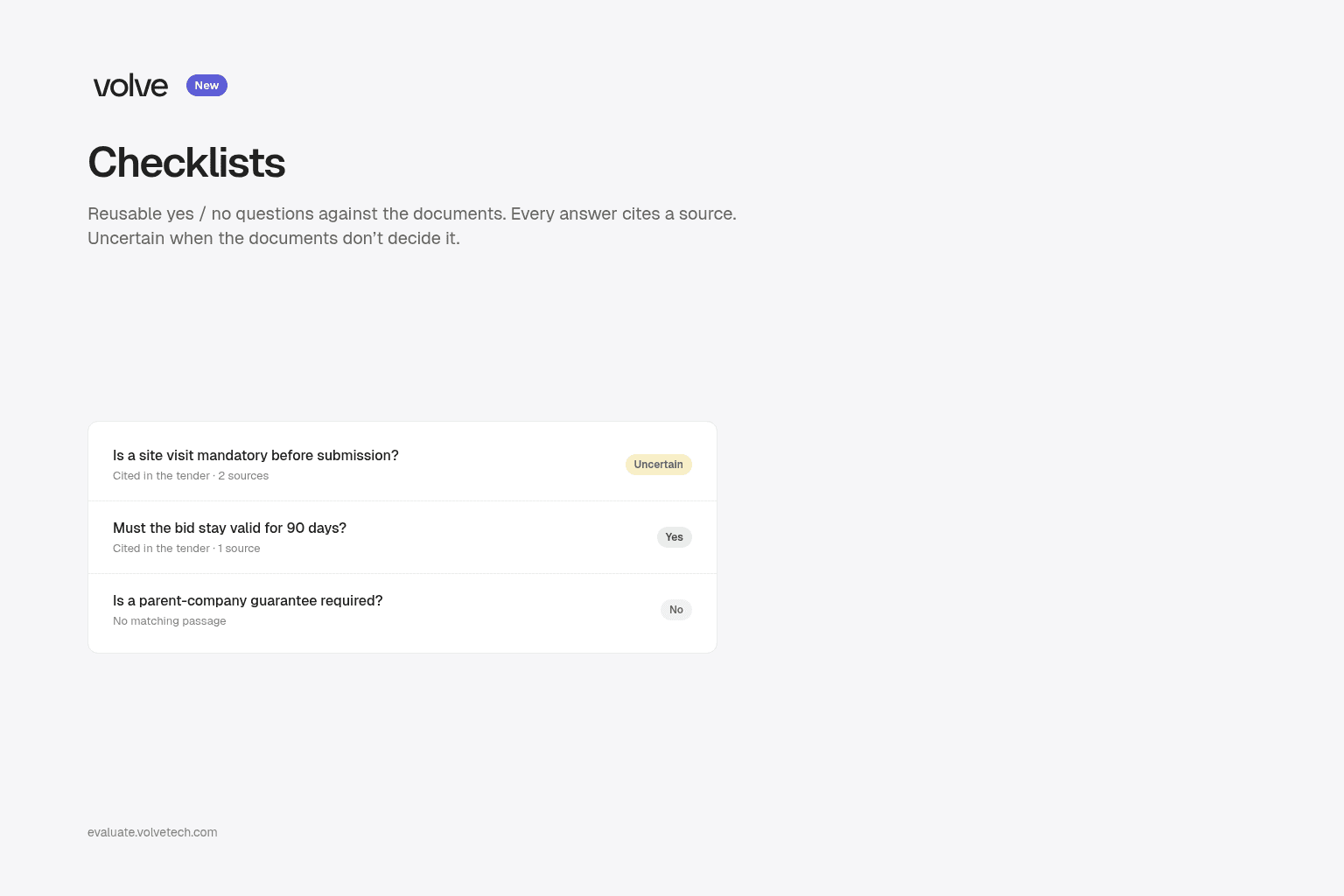
Ask which drawings conflict with the concrete spec and the answer arrives with its sources, each one a node you can open. The chat is a way into the graph, not a substitute for it.
A school, a metro line, a dam and a hospital share their civils and almost nothing else that decides the price. The structure that holds them has to know that.
Herman B. Smith
CEO & Co-Founder
Share
See how Volve turns document complexity into decisions
Explore how construction teams surface risk, trace requirements, and carry a clearer baseline into delivery.