Contract Review in Construction Isn't Inconsistent by Accident
Why contract review in construction is inconsistent across teams, and how structured red flag review makes clause decisions repeatable.

Key takeaways
Inconsistent construction contract review often stems from process failures rather than rational differences in risk appetite between individual project managers.
Using standard contract forms like NEC or FIDIC allows firms to baseline expected risk allocations and isolate deviations for targeted commercial assessment.
Documenting every red flag and identified deviation ensures commercial decisions remain traceable, providing essential protection for project margins if disputes arise after contract award.
Every commercial manager has a version of the same story. They flag a clause as a serious problem. A colleague in another office accepts it without comment. Same clause, same project, same client. Different result.
Sometimes that’s rational. Sometimes it’s a process failure. Knowing which one you’re dealing with is the whole problem.
The same clause, read differently
Contractors read tender contracts with one practical question: is this risk manageable and priceable. If not, the next step is equally practical. Amend. Qualify. Price. Escalate.
Clients read the same contract through a different lens: will this procurement deliver predictable outcomes and competitive bids. Terms that look protective from one side look like a market problem from the other.
Even within the contractor market, red-flag thresholds shift depending on pipeline pressure, delivery model, balance sheet, bonding capacity, and internal governance. A contractor with full utilisation may walk away from risk that another accepts to keep teams busy. The same LD clause is material exposure for one firm and a manageable contingency for another.
This variation is often rational. The method should accommodate it.
Topic | Contractor red flags | Client market response |
|---|---|---|
LDs | Uncapped. Triggers when delay is client-driven. | Fewer bidders. Higher contingency. |
On-demand bonds | Callable without cure or sunset. | Financing cost rises. Bidder pool shrinks. |
Ground risk | “Accept all conditions” with weak survey basis. | Inflated pricing. Claims when reality diverges. |
Payment terms | Broad set-off. Pay-when-paid. Weak certification. | Supply chain instability. Programme risk. |
Where it stops being rational variation
The problem isn’t that two people read the same clause differently. The problem is when the method is inconsistent. When there’s no stable reference point, review adapts to whoever has time that week rather than to the actual risk picture.
Two failure modes show up repeatedly.
One-size-fits-all judgement. Flagging clauses as simply good or bad regardless of who is reading them or why. The output looks rigorous but doesn’t map to real decisions.
The opposite extreme. Everything becomes “it depends,” without a baseline. Different reviewers produce different results on the same document. People stop trusting the output.
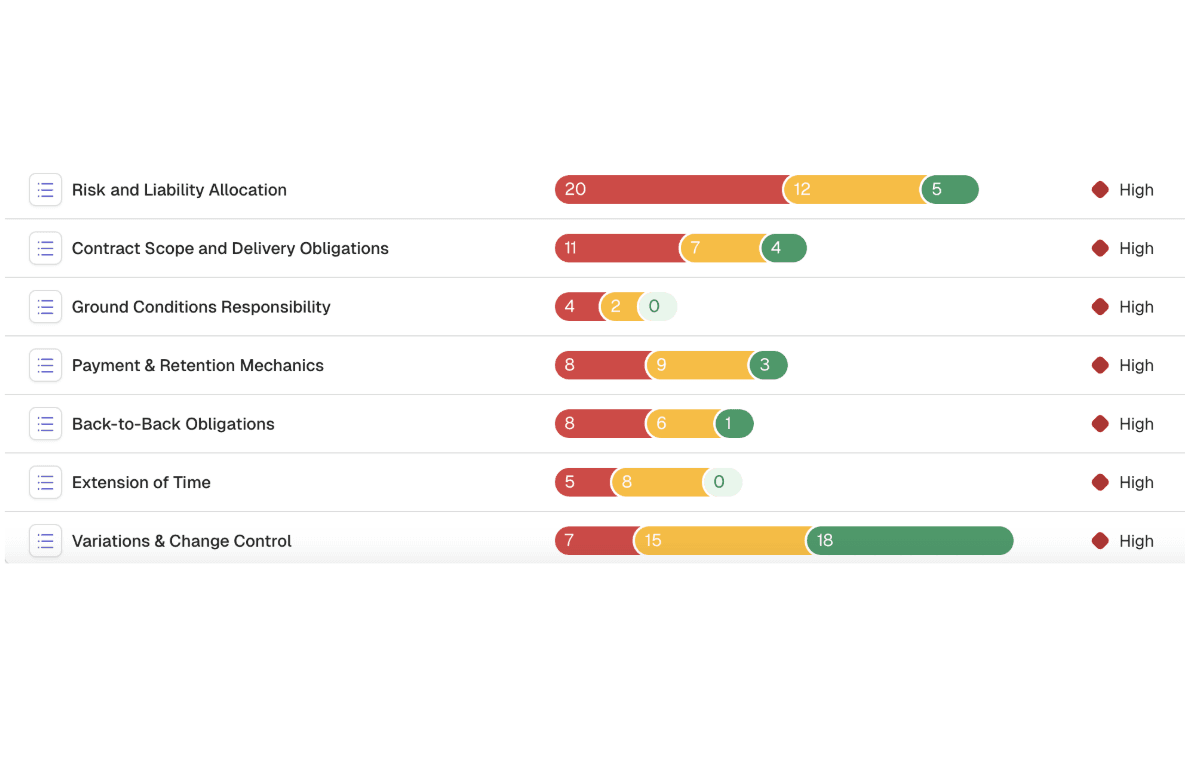
What actually works is separating the method from the lens. The method stays constant: identify relevant clauses, group by domain, compare against baseline positions for the forms you work with, flag deviations with traceable citations. Standard forms like NEC, FIDIC, and NS 8405/8407 give you a tested reference point for what balanced risk allocation looks like. Deviations from those positions are where attention should concentrate.
The lens is yours: your thresholds, your approval triggers, your standard positions. Same clause, same flag. Different recommended action depending on who is reading it and what their constraints are.
The cross-document detection problem
A single-document red-flag review is tractable. The problem is that construction contracts are never a single document.
The governing set typically includes the contract form, special conditions, employer’s requirements, technical specifications across disciplines, Q&A logs, addenda, and subcontract terms that need to be assessed for flow-down risk. Deviations from standard positions can sit in any of these. A clause in the employer’s requirements overrides a term in the contract conditions. A clarification in the Q&A log changes risk allocation on an item already priced. An addendum issued on day 14 of an 18-day window changes a payment clause three estimators priced on the old basis.
Under pressure, these don’t get caught systematically. They get caught depending on who had time. The document set is too large, too distributed, and too interconnected for individual review to solve this reliably across every bid.
This is where structured AI review changes the calculation. Not by replacing commercial judgement, but by applying the method consistently across the full document set, so deviations and cross-document conflicts surface before submission rather than after award.
What a traceable record is actually worth
One under-discussed cost of inconsistent review shows up after award.
When a dispute forms around a clause, the first question is what was understood during tendering. Was it flagged? Was a price allowance made? Was it escalated and accepted by someone with authority?
If review was undocumented, there are no clean answers. The commercial position depends on what individuals remember.
When review is structured and traceable, a different conversation is possible. The clause was flagged. The deviation from the NEC baseline was identified. The decision to accept it was made at the right level and recorded. That’s a defensible position, commercially and internally.
Review documentation isn’t bureaucracy. It’s the record of commercial decision-making that protects margin in delivery.
Read more about how Volve’s updated contract review works, including red flag definitions, standard position benchmarking, and cross-document detection, HERE.
See how Volve turns document complexity into decisions
Explore how construction teams surface risk, trace requirements, and carry a clearer baseline into delivery.