The invisible bottleneck in modular construction
Most modular construction failures start in preconstruction, not the factory. The two capabilities that decide industrialised construction.

Key takeaways
Modular construction initiatives frequently falter because preconstruction processes remain optimized for traditional stick-built projects instead of the rigid requirements of industrialised fabrication.
Design decisions must be fully coordinated and locked in before manufacturing begins because industrialised modular workflows lack the on-site recovery paths typical of conventional projects.
Success in industrialised construction depends on implementing a decision discipline that ensures high-quality risk assessment and clear traceability for every contractual commitment made during preconstruction.
Katerra raised more than two billion dollars to industrialise construction. It went bankrupt in 2021.
The widely accepted lessons focus on overreach and vertical integration. But the less discussed lesson is more useful for the rest of the industry: getting the factory right matters less than getting the information right before manufacturing begins.
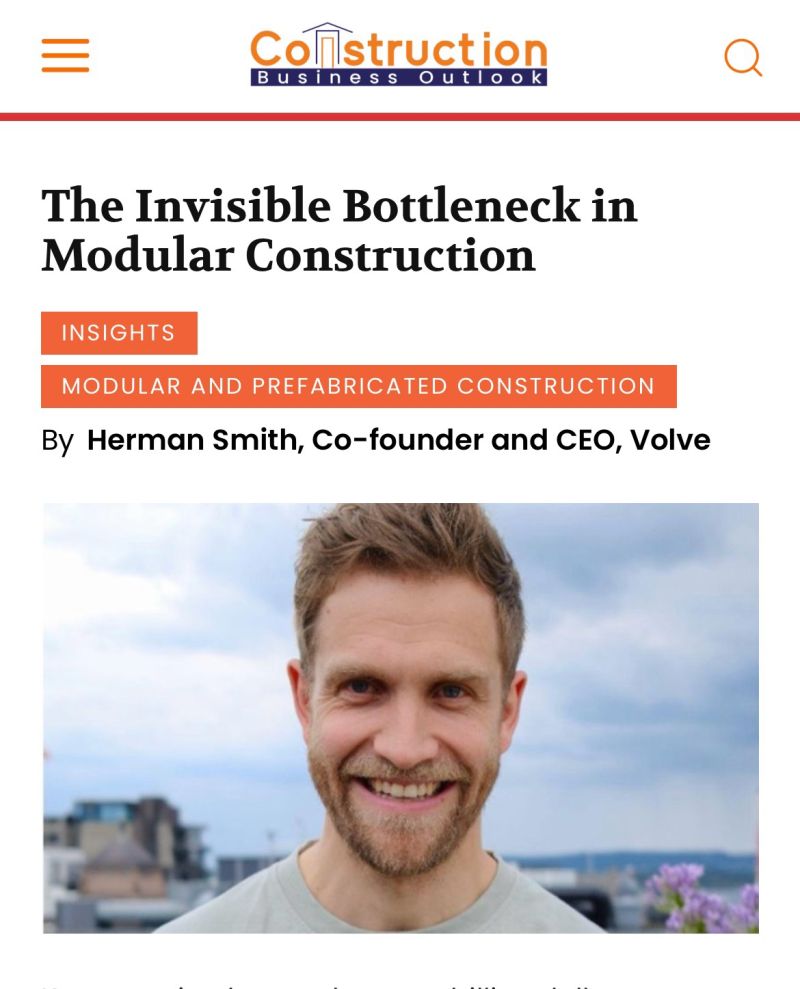
Volve CEO and co-founder Herman Smith writes in Construction Business Outlook’s recent edition on Modular and Prefabricated Construction about why the preconstruction process feeding most modular projects is still designed for stick-built work, and why that mismatch is the most important unmanaged constraint on industrialised construction’s promise.
Why preconstruction becomes the bottleneck
In conventional construction, decisions can be corrected on site. A misread specification becomes a change order. A misunderstood obligation becomes a claim. The cost is real but usually absorbable. Industrialised construction operates under different constraints.
Design information must be coordinated earlier, procurement commitments happen sooner, and by the time a module leaves the factory, the decisions that shaped it are mostly locked. An overlooked specification or contractual ambiguity doesn’t just create rework. It cascades through fabrication, logistics, and installation, often with no on-site path to recovery.
That raises the stakes on what preconstruction has to be. Not a document discipline. A decision discipline.
The two capabilities that matter
Herman argues that two distinct capabilities define whether it succeeds:
- Decision quality, did we identify the right risks, price them correctly, and turn down the wrong opportunities?
- Decision traceability, can we reconstruct, after the fact, what we knew when we made a commitment, and on what basis we accepted a given risk?
These are not the same thing, and they don’t scale the same way. The absence of either is where most modular initiatives quietly fail.
Read the full article in Construction Business Outlook here 🔗
See how Volve turns document complexity into decisions
Explore how construction teams surface risk, trace requirements, and carry a clearer baseline into delivery.