Used on more than 2,500 construction tenders and contracts

















What it covers
A standard form is broadly balanced as written. The risk usually moves in the amendments.
Volve returns these six things from each contract.
Deviations from the form
Where the contract departs from the standard form you uploaded, clause by clause.
Risk allocation
Who carries ground, design, delay and price risk, and how that differs from the form.
Time bars
Notice periods and fixed days, what triggers each one and what is lost if it is missed.
Obligations
What you commit to, when and to whom, listed with the clause behind each.
Payment and liability
Payment terms, retention, damages and caps, and where the limits sit.
Your positions
Your own red lines and checklist applied to every contract, so the same flags appear each time.
How it works
Upload the contract and the standards you work with. Volve compares them and returns each departure with its clause.
Your standards
Upload the standard form, your company positions and your bid checklist. Volve compares the contract with them clause by clause, whichever form you contract on.


Red flags
Each flag shows your position, what the contract says and the clause behind it. Your team decides whether to accept, price, qualify or push back.
Consistency
Your positions and checks run the same way on every contract, so the review does not depend on who reads it or how late it arrives. Findings stay linked to their clause and carry forward to the project team.
Compared
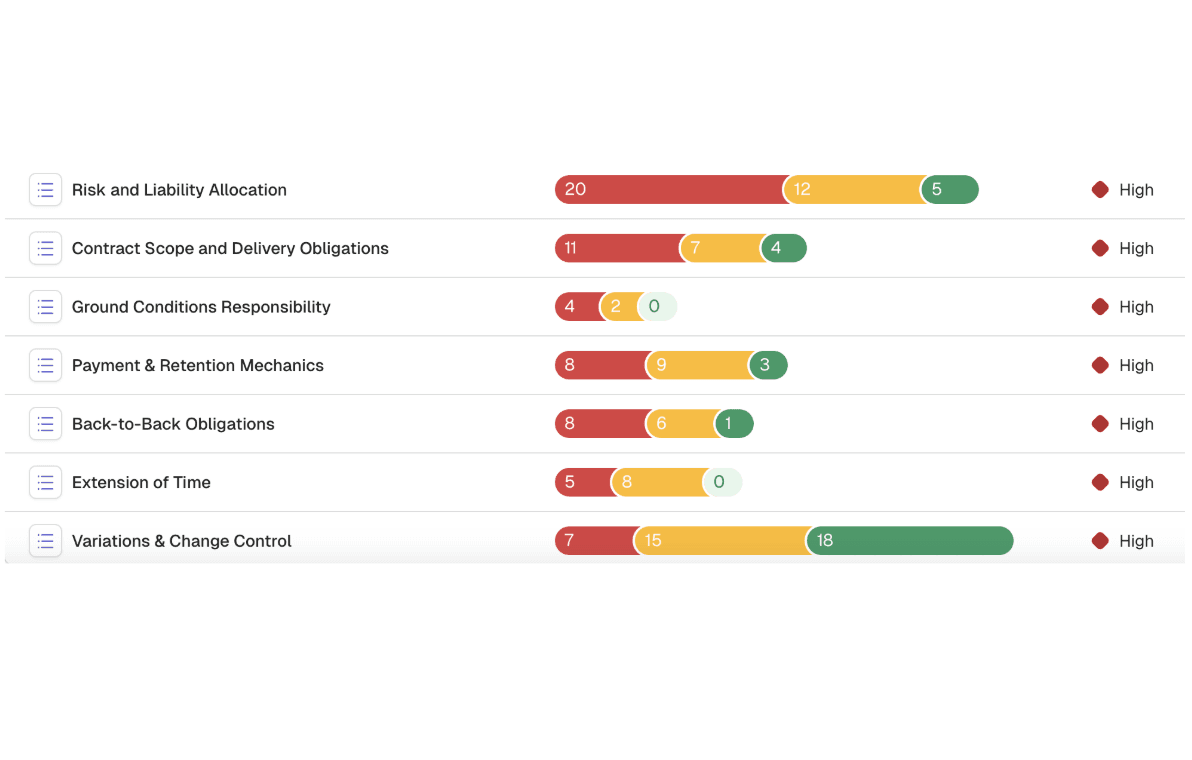
Most teams review contracts by hand or with a general assistant. Here is how that compares.

Last verified: November 2026
VOLVE INSIGHTS
Contract Review in Construction Isn’t Inconsistent by Accident
Why contract review in construction is inconsistent across teams, and how structured red flag review makes clause decisions repeatable.
See what a contract says.
Clause by clause.
Bring a contract and the form you work on. We show the deviations, obligations and time bars Volve flags, each with its clause.
FAQ