Bid development in Volve, rebuilt
Qualification, formal requirements and the scored bid, kept apart, checked for coverage and assessed against the award criteria.


Key takeaways
Every requirement lands in one of three places: qualification, formal requirements, or the scored bid.
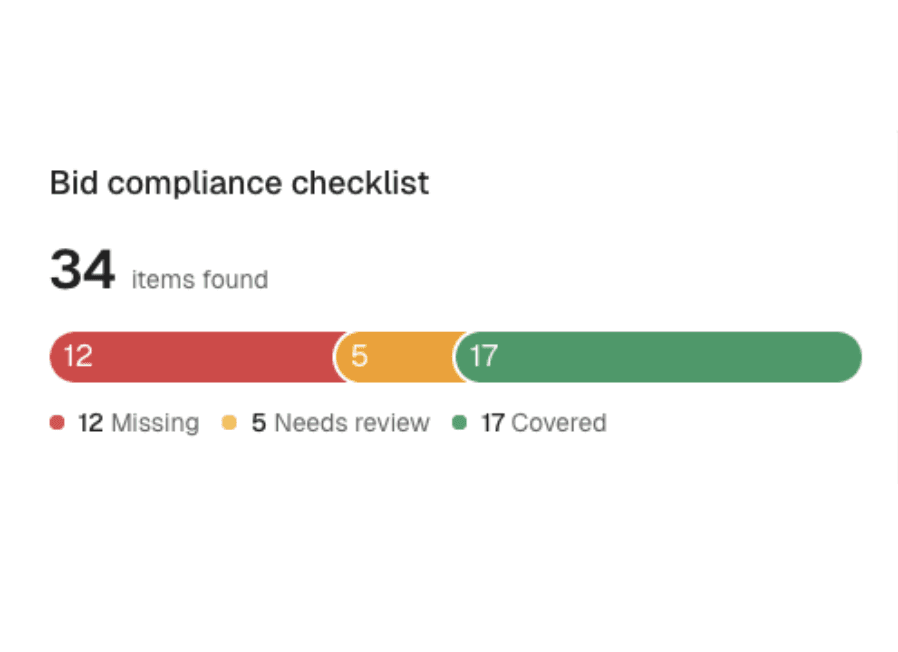
One check above both working areas: requirements responded to, out of how many the pack contains.
The scored deliverables are assessed against the award criteria, with the weighting beside each.
The whole team works one bid in parallel. The decisions stay with the team.
A bid is evaluated in three ways: pass or fail on who you are, pass or fail on the formal requirements, and points on the deliverables. A compliance matrix treats all three as one list. Bid development in Volve has been rebuilt around the difference.
What it does
Three parts, kept apart. Every requirement found anywhere in the pack lands in one of three places. Qualification: who you are, capacity, references, certificates. Formal requirements: pass or fail, no points, format, deadlines, signatures, the process steps the client sets. And the scored deliverables, the bid itself: method, programme, team, quality, what the evaluator gives marks for. Qualification and the bid are separate working areas.
Drafting, upgraded. Drafting the scored deliverables has been in Volve since the start, and it is where teams have found the most value on the qualitative parts of a bid. It now starts from the requirement and the award criterion it is scored under, with your earlier responses to hand, so a draft begins where the points are.
Coverage check. Above both working areas sits one check: how many requirements have a response, out of how many the pack contains. A compliance matrix tells you a requirement was answered. This tells you whether every requirement the pack contains was, including the ones that sat in an annex.
Assessed against the criteria. The scored deliverables are assessed criterion by criterion: strengths, weaknesses and suggestions, with the weighting beside each, so the remaining days go where the marks are. An assessment, not a predicted score.
One bid, the whole team. Everyone works the same bid in parallel, with progress visible per deliverable, and a tender can carry more than one bid, as drafts or stages.
Why the split matters
The invitation holds the main rules. A handful of requirements for the bid sit elsewhere in the pack, in the specification, the contract, the Q&A, and they have to be responded to like any other. Bids lose on those more often than on the rules everyone read.
“We see it over and over again. The invitation holds the main rules, but a few requirements for the bid are spread across the other documents, and they have to be responded to too.”
That is what the coverage check is for, and why every requirement is placed in one of the three parts before anyone starts writing.
Where it fits
Public tenders are won on compliance and award criteria, private ones often on price, negotiation and fit. Volve works from the tender’s own requirements in both. The decisions stay with the team: what to claim, what to promise, how to price.
The full picture is on the bid development page, the patterns a bid loses on are in Top 7 reasons compliant construction bids lose, and the quickest way to see it is to see Volve on a tender like yours.
See how Volve turns document complexity into decisions
Explore how construction teams surface risk, trace requirements, and carry a clearer baseline into delivery.