Playbooks are live in Volve
Save the analyses you repeat and run them on the next project, as your own, your organisation’s or Volve’s Playbooks, with the result as a working document.


Key takeaways
A Playbook is a saved task, not a saved answer: the question, the structure and the rules.
It runs on the project’s documents and lands as a working document the team edits.
It can draw on the knowledge base: your risk method, your standards, the environmental taxonomy.
Your own, your organisation’s, or Volve’s. Checklists stay separate; both repeat.
Every tender team has analyses it runs every time: the risk drivers for this project type, the quantity status before pricing, the main phases before the programme is built. Most of them live as a prompt someone wrote once, in a chat nobody can find, redone from memory on the next project. Playbooks make them something the whole team keeps.
What it does
A saved task, not a saved answer. A Playbook is the task itself: the question, the structure of the answer, the rules it follows. Run it on a project and it works on that project’s documents. On the next project it gives the same structure, so the results compare. A prompt library stores the words. A Playbook stores the task, and the documents and references it runs on.
The result is a working document. A Playbook lands as a document in the project, edited and shared like any other, not as a chat reply that scrolls away. The team works from it, and it is there when the bid is handed over.
Built on your references. A Playbook can draw on the knowledge base alongside the project documents: your own risk method, the contract and technical standards you work to, the EU taxonomy or whichever environmental criteria the client scores against. The task then runs against your references, not against a general reading of the subject.
Yours, your organisation’s, or Volve’s. Save the tasks you repeat as your own Playbooks. Share the ones the whole company should run the same way as organisation Playbooks. Volve’s own come with the platform.
Where it has the most effect. The analyses every tender needs: a one-page scope summary before the go or no-go call, a quantity status before pricing, a main phase plan, the execution risk drivers for the project type, the environmental requirements against the criteria the client scores. One rule serves them all: figures from the tender documents only, and what the documents do not give is marked as not specified.
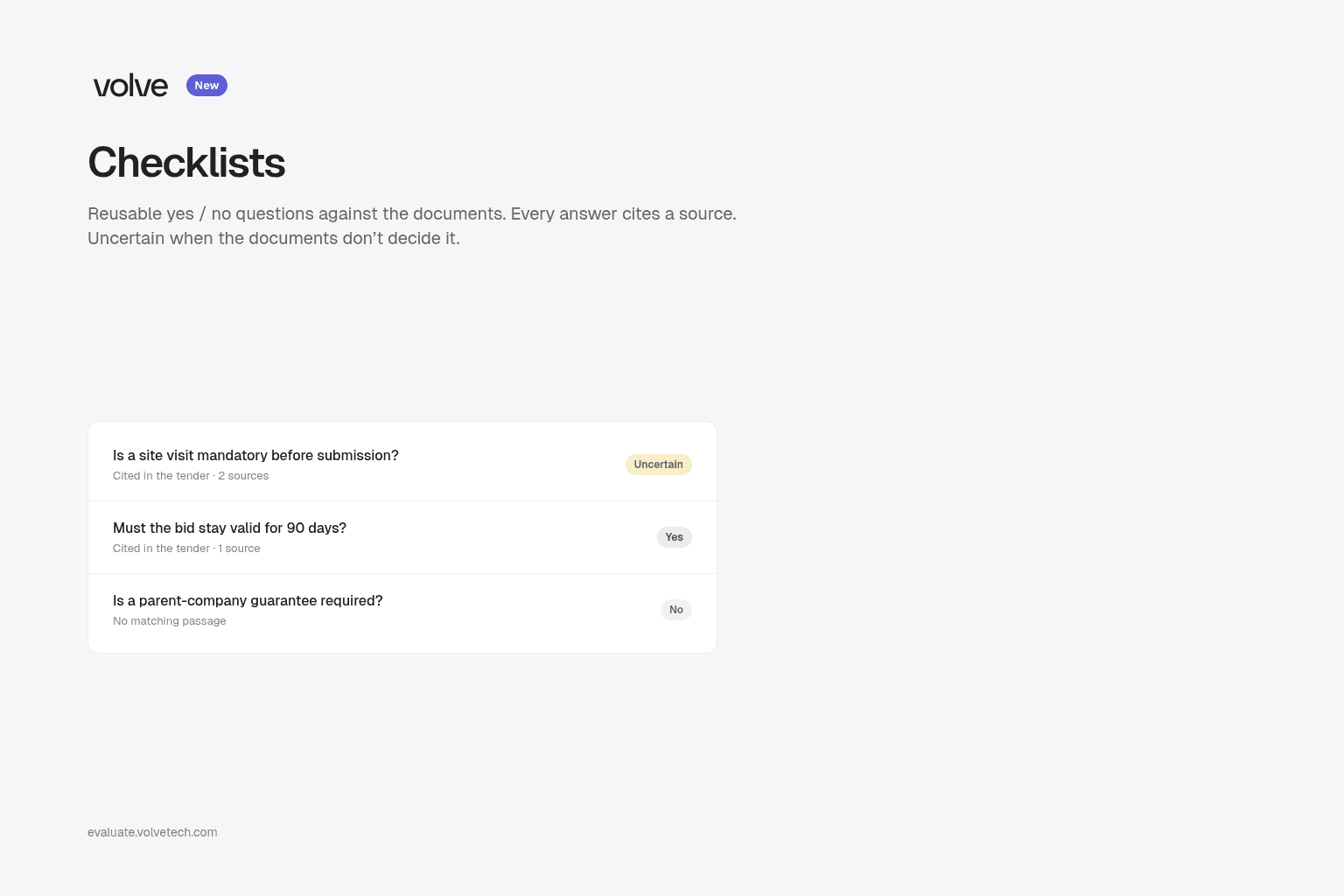
Checklists stay separate. Checklists give yes or no answers with the failure state defined in advance. Playbooks produce the analysis. Both run on the same uploaded documents, and both are built to be repeated.
Where it fits
With Playbooks, Volve takes another step towards turning key tasks into processes that repeat from project to project: the same work, done the same way, by everyone on the team, in a form the next project starts from. That, more than any single answer, is where AI earns its place.
They sit in the Across every project section of the features page, and the quickest way to see one run is to see Volve on a tender like yours.
See how Volve turns document complexity into decisions
Explore how construction teams surface risk, trace requirements, and carry a clearer baseline into delivery.